Before a touch probe can be used for tool setting, its length must be entered in the F4 Tool Table. The method depends on which type of tool setter your machine has.
Applies to
MASSO G3 and G3 Touch, mill
You need
Working Probe and Tool Setter inputs, Auto Tool Zero set up
Result
Probe Z offset stored in the F4 Tool Table
Choose your method
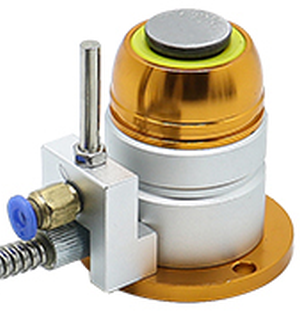
Tool setter
How it detects contact
Method
Plate
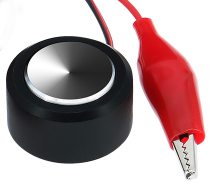
A conductive plate (usually aluminium). The tool completes an electrical circuit.
The probe is measured only once, so its length must not change between uses.
Automatic tool changer: mount the probe in a tool holder.
Manual tool change (collet): push the probe into the collet until it stops against the collet nut.
Plate tool setter method
The probe is temporarily used as the tool setter input, so Auto Tool Zero measures it against the plate.
CAUTION
Follow these steps in order to avoid damaging the probe.
1
Make sure Auto Tool Zero is set up and working, then home the machine.
2
Load the probe: Txx M6 (xx = probe tool number).
3
On F1-Setup, note the current input assignments, then change the probe's input from Probe to Tool Setter. Touch the probe: the input must go HIGH.
BeforeAfter
4
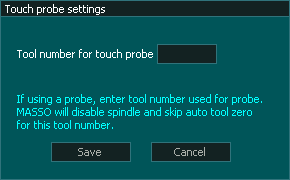
In F1-Setup › Touch Probe, make sure no tool number is assigned. Otherwise Auto Tool Zero skips the probe and the next step won't work.
5
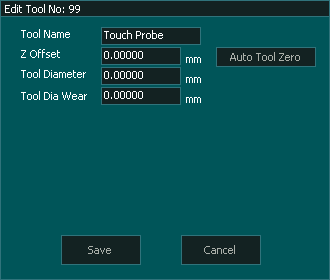
On F4-Tool Table, open the probe tool and press Auto Tool Zero. The probe moves down, stops on the plate and retracts. The Z offset updates to the probe length. Press Save.
6
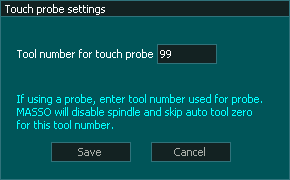
Back in F1-Setup › Touch Probe, enter the probe's tool number and press Save.
7
Set the Probe and Tool Setter inputs back to their original assignments.
CHECK
The Probe input goes HIGH when you touch the probe, and the Tool Setter input goes HIGH when you ground the tool setter. Calibration is complete.
Switch tool setter method
When both the tool setter and the probe contain switches, one always triggers before the other, so measuring the probe on the tool setter gives a wrong result. Instead, compare the probe against a normal tool on a shared reference surface.
CAUTION
Follow these steps in order to avoid damage. They assume separate inputs are already assigned for Probe and Tool Setter.
1
Make sure Auto Tool Zero and the touch probe are set up and working, then home the machine.
2
Load a standard tool such as an end mill: Txx M6.
3
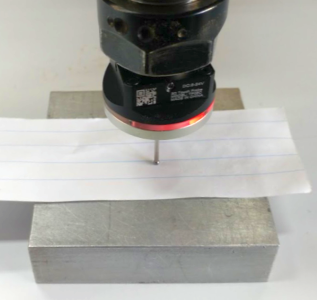
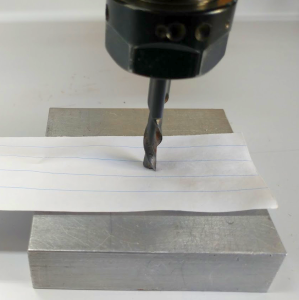
Place a block on the table. Slowly jog the tool down onto a piece of paper on the block and stop when the paper just drags.
4
Set the Z axis DRO to 0.
5
Load the probe: Txx M6.
6
Disable Auto Tool Zero: in F1-Setup › Auto Tool Zero, untick the option and press Save.
7
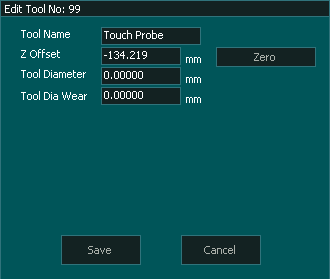
On F4-Tool Table, open the probe tool, set Z offset = 0 and press Save.
8
Jog the probe down onto the same surface, with the paper still in place if you used it. Stop as soon as the probe indicator shows the probe has triggered.
9
Read the Z axis DRO. The probe Z offset is the negative of this value. Example: DRO shows 134.219, so the offset is −134.219.
10
On F4-Tool Table, open the probe tool, replace the Z offset with the new value and press Save.
11
Re-enable Auto Tool Zero. The probe length is now calibrated.
More accurate: touch off with G38.2
In steps 3 and 8 you can probe with G38.2 instead of jogging. It is more accurate because axis resolution is finer than the smallest jog step. For step 3 the block must be wired as a probing touch plate. Don't use paper with this method, and start close to the surface to save time. Enter in MDI:

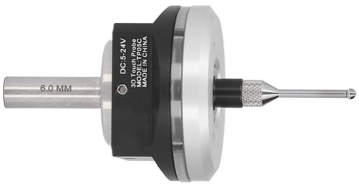
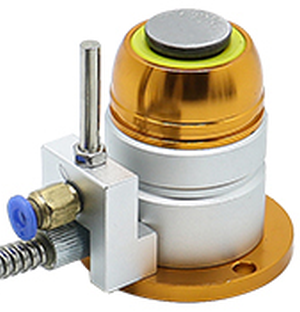



 shows the probe has triggered.